Procurement Automation in the UAE: Quotes, Purchase Orders and Supplier Follow-Up With AI
By AI Meets Real teamPublished 5 min read
Key takeaways
Procurement automation starts with the email-heavy steps: requests for quotes, quote comparison, approvals and delivery follow-up.
An AI procurement agent drafts and chases; a person approves suppliers, prices and anything that commits money.
Clean supplier and invoice data now pays twice, because UAE e-invoicing starts for large businesses in 2027.
Measure cycle time from request to purchase order before and after, and the number of approvals stuck for more than two days.
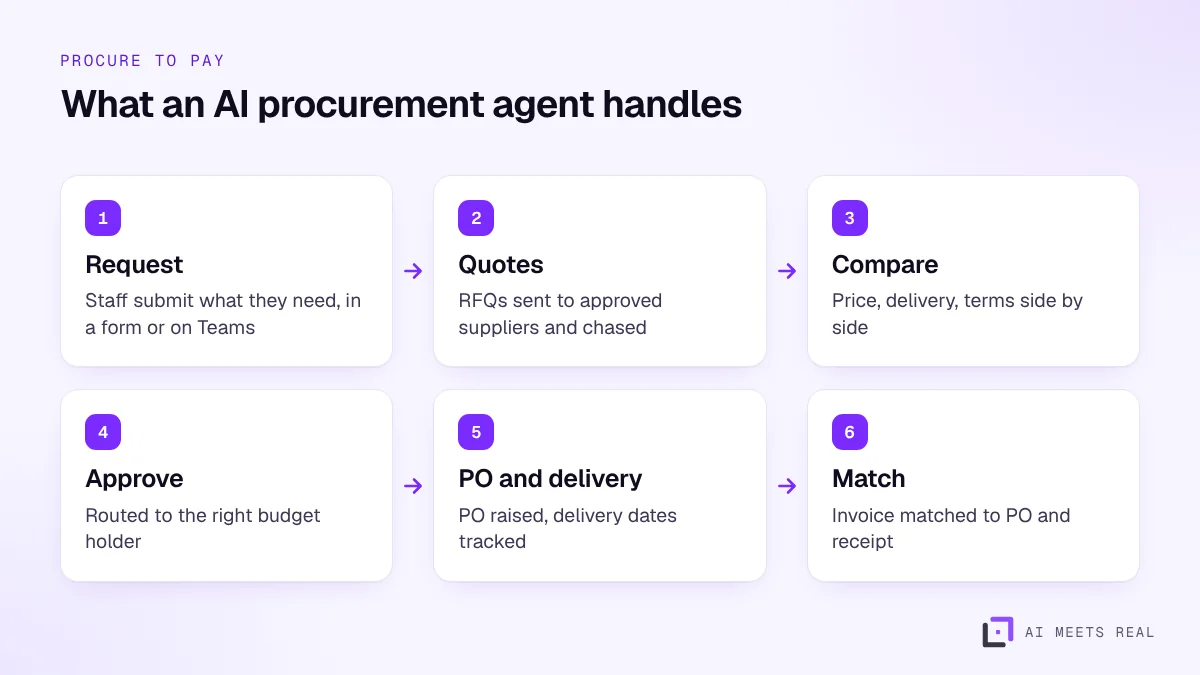
Procurement automation in the UAE means letting software, increasingly AI agents, handle the repetitive parts of buying: sending requests for quotes, reading and comparing the replies, routing approvals, raising purchase orders, chasing deliveries and matching invoices. Your team keeps control of suppliers, prices and spending. The rest is mostly email, and that is where most of the time goes.
The email load is real. Microsoft's Work Trend Index found the average worker receives 117 emails a day and is interrupted roughly every two minutes during core hours (Microsoft WorkLab). In procurement, much of that is quotes, approvals and delivery questions. UAE teams are also ready for the change: Microsoft's AI Diffusion Report ranked the UAE first in the world for AI adoption, with 70.1% of the working-age population using AI tools in early 2026 (Gulf News).
Which procurement steps should you automate first?
Start with the steps that are frequent, rule-based and easy to measure:
Requests for quotes. The agent sends RFQs to your approved suppliers from a standard template, with the specification and the deadline, and chases the ones who have not replied.
Quote comparison. Quotes arrive as PDFs, spreadsheets and email text. The agent reads them, puts price, delivery time, payment terms and validity into one table, and highlights gaps.
Approval routing. Each purchase goes to the right budget holder based on amount and cost centre, with reminders when it waits too long.
Purchase orders. Once approved, the PO is raised in your ERP or accounting system and sent to the supplier.
Delivery follow-up. The agent tracks promised dates and asks suppliers for updates before an item is late, not after.
The agent does the drafting and chasing at each step; approvals stay with people.
Choosing and approving suppliers, especially new ones.
Accepting prices and terms above an agreed threshold.
Negotiation, where relationships and judgment matter.
Exceptions: urgent purchases, single-source items and disputes.
The agent recommends with reasons; the buyer decides. Every action is logged, so you can always see who approved what and when. This is the same control model we use for all agents, described in our agent governance framework.
How does AI compare supplier quotes?
A good comparison is more than the lowest price. The agent puts each quote into the same structure:
Unit price and total, in AED, with VAT shown separately.
Delivery date and what the supplier committed to in writing.
Payment terms and quote validity.
Missing items or substitutions the supplier made.
Past performance, if you track on-time delivery and quality.
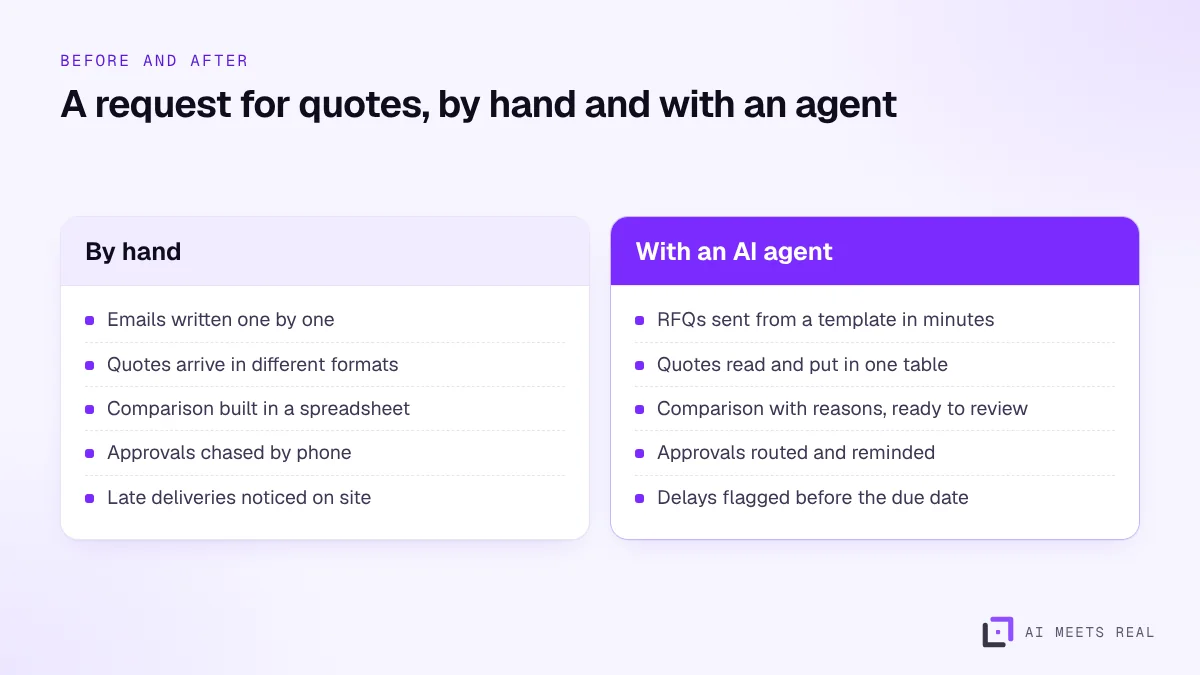
Same process, same approvals: the agent removes the copying and chasing.
The buyer sees one table with a recommended option and the reasons, instead of six attachments.
How does e-invoicing change procurement?
The UAE is moving to electronic invoicing, with large businesses first from 2027, so supplier invoices will arrive as structured data instead of PDFs (KPMG). That makes three-way matching, between the purchase order, the goods received and the invoice, much easier to automate.
It also means messy data becomes expensive. Supplier names spelled three ways, missing tax registration numbers and POs raised after the invoice all break automatic matching. Fixing your supplier master data now pays twice: once for today's automation and again when e-invoicing arrives. Our guide to the UAE e-invoicing timeline explains the dates and the preparation.
Does it work with our ERP?
Usually yes. An AI procurement agent connects to:
Your ERP or accounting system, through its API or scheduled exports, to read budgets and raise POs.
The procurement mailbox your suppliers already use.
Teams, Outlook or WhatsApp for internal requests and approvals.
You do not need to replace the ERP. The agent sits on top of it and handles the steps the ERP leaves to email.
How do you measure the result?
Write down a baseline before you start:
Cycle time from purchase request to approved PO.
Quotes per request and how long suppliers take to reply.
Approvals waiting more than two working days.
Late deliveries and how early you knew about them.
Buyer hours spent on copying and chasing.
Compare after four to six weeks. Our ROI model shows how to turn hours saved and faster cycles into a monthly return.
What does a first rollout look like?
Most teams start with one category, such as office supplies, IT equipment or site consumables, and one approval route. A 14-day pilot on real requests shows the cycle time and the hours saved before you extend it to more categories and suppliers.
What mistakes slow procurement automation down?
Starting with the hardest category. Capital equipment and single-source items have too many exceptions for a first project. Start with frequent, simple purchases.
Messy supplier records. Duplicate suppliers and missing tax numbers break matching. Clean the supplier list before you switch on automatic matching.
Approval rules nobody wrote down. If thresholds live in people's heads, the agent cannot route correctly. Write them down first; it usually exposes a few gaps worth fixing anyway.
Automating around the ERP. Keep the ERP as the record of truth. The agent should read from it and write to it, not keep its own copy.
No owner. Someone in procurement must own the agent, its rules and its results.
A worked example
With illustrative numbers: a facilities company raises about 300 purchase requests a month for site consumables. Each one takes a buyer around 45 minutes across sending RFQs, comparing three quotes, chasing approval and raising the PO. That is roughly 225 buyer hours a month.
With an agent sending the RFQs, building the comparison and routing approvals, the buyer spends perhaps 10 to 15 minutes reviewing and approving each request. The same 300 requests then take 50 to 75 hours, and the request-to-PO time falls because approvals no longer wait in someone's inbox. The pilot measures the real figures before any wider rollout.
What is the next step?
Pick one category where requests pile up and book a 30-minute demo. We will run a real request from quote to purchase order with an AI agent, and show where your buyers approve each step.
Frequently asked questions
What is procurement automation?
Using software, including AI agents, to handle the repetitive parts of buying: collecting quotes, comparing them, routing approvals, raising purchase orders, following up deliveries and matching invoices. People still approve suppliers, prices and spending.
Can AI choose suppliers?
AI can compare quotes on price, delivery time, terms and past performance and recommend one with its reasons. The decision and the approval should stay with your procurement team.
Does procurement automation work with our ERP?
Usually yes. The agent connects to your ERP or accounting system through its API or exports, and to the mailbox your suppliers already use. You do not need to replace the ERP.
How does e-invoicing affect procurement?
UAE e-invoicing means supplier invoices will arrive as structured data. Matching them to purchase orders and goods received becomes faster and easier to automate if your supplier records and PO data are clean now.