AI in Recruitment in the UAE: Screening, Interviews and the Rules to Follow
By AI Meets Real teamPublished 6 min read
Key takeaways
AI is best at the high-volume early stages of hiring: reading CVs, answering candidate questions, first-round interviews and scheduling.
Final decisions, offers and anything that rejects a person on judgment should stay with a named human reviewer.
UAE labour law bans discrimination at every stage of recruitment, so screening rules must be job-related and checked for bias.
Candidate data falls under the UAE's data protection law: collect only what the role needs, explain how it is used and keep it secure.
UAE employers use AI in recruitment to read every CV against the same criteria, run a structured first interview at any hour, answer candidate questions and book interviews automatically. It works best on the high-volume early stages of hiring. Final decisions, offers and judgment calls should stay with a named person, and the screening rules must follow UAE labour law and data protection rules.
Where does AI save the most time in hiring?
Most hiring teams lose time in the same places: reading hundreds of CVs for one role, answering the same questions about salary, visa and start dates, and chasing candidates to book interviews. These tasks are repetitive, follow rules and happen at volume, which is exactly where AI does well.
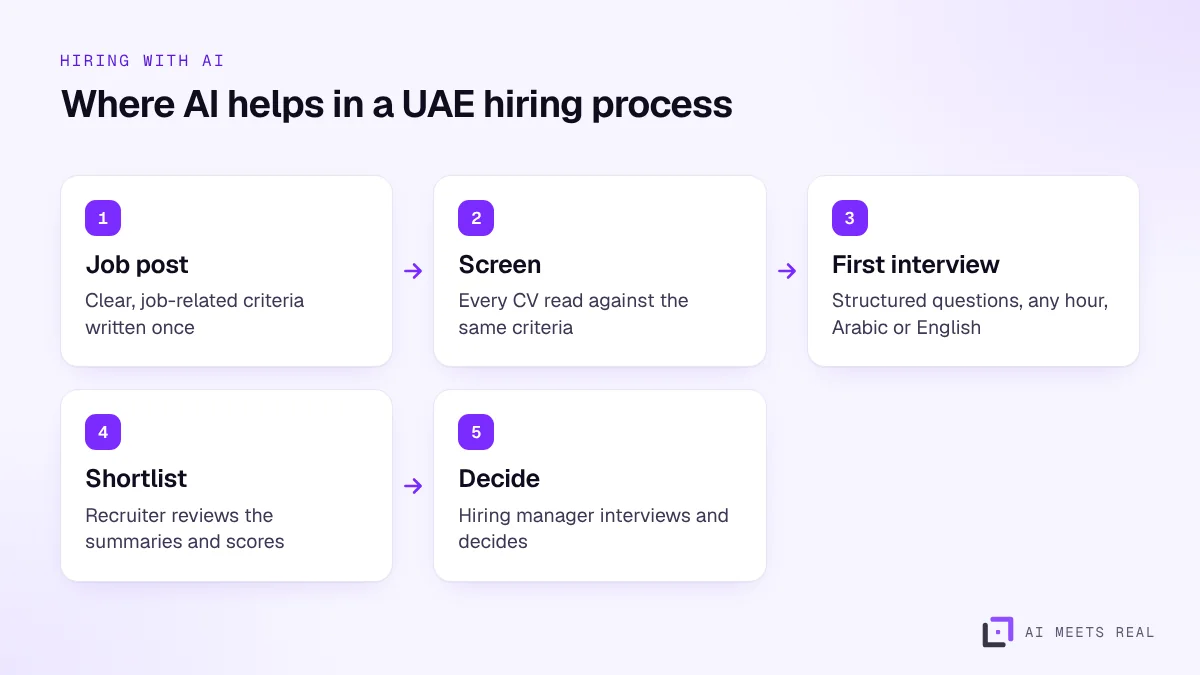
Typical jobs for an AI recruiting agent:
CV screening. Every application is read against the criteria you set: required experience, licences, languages and skills. Each candidate gets a short summary and a score with the reasons.
Candidate questions. Questions about the role, the location, working hours and the process are answered on WhatsApp, email or the careers page, in Arabic or English.
First-round interviews. A structured interview by chat, voice or video, with the same questions for every candidate, summarised for the recruiter.
Scheduling. Interview slots are offered from the hiring manager's calendar, confirmed and reminded.
Status updates. Every candidate hears back, including the ones who are not shortlisted.
AI prepares each stage; people decide at the shortlist and the final interview.
Our AI for HR page shows the full set of HR workflows we automate, from hiring to onboarding.
What should stay with a person?
Keep a named person responsible for anything that decides a candidate's future:
The final shortlist and the hiring decision.
Offers, salary and contract terms.
Rejections at the later stages, where judgment matters most.
Any case the AI flags as unusual: career breaks, non-standard qualifications, internal candidates.
A good setup lets the agent prepare the work, a recruiter approve it in one step, and the agent send it. The same rule we use for every agent applies here: nothing leaves the company without approval, and every action is logged. Our agent governance framework explains how owners, approvals and run logs work in practice.
What does UAE law say about AI in recruitment?
There is no separate UAE law for AI in hiring, but the existing rules apply to every tool you use.
Non-discrimination. UAE labour law prohibits discrimination at all stages of employment, including recruitment. Job adverts, shortlisting, interviews and assessments must not discriminate on grounds such as gender, race or ethnicity, nationality or social origin, religion or disability (Mondaq). An AI that learns from past hiring decisions can repeat old patterns, so set the criteria explicitly and test the results.
Relevant questions only. Ask only for information the role needs. Questions about marital status, religion or personal finances are inappropriate unless they relate to the job, and background checks should be done with consent.
Data protection. Candidate data is personal data. The UAE's Personal Data Protection Law (Federal Decree-Law No. 45 of 2021) has applied since 2 January 2022 (UAE Government portal). Tell candidates how their data is used, keep it secure, and delete unsuccessful applications on a fixed schedule. Our PDPL checklist for AI projects covers the details.
Offers and contracts. Written offers must be registered with MOHRE or the free zone authority, and the final contract must match the offer. AI can draft both, but a person should check and send them.
How does AI help with Emiratisation?
Emiratisation targets apply to many private companies. Companies with 50 or more workers must increase the number of Emiratis in skilled roles by 2% each year, and companies with 20 to 49 workers in growth sectors were required to hire at least one Emirati before 1 January 2026 (Gulf News).
AI does not change the targets, but it helps you meet them:
Faster response to national candidates, so strong applicants are not lost to slower employers.
Arabic-first communication on WhatsApp and the careers page.
Clear tracking of every Emirati applicant through each stage, so HR can report progress at any time.
How do you set up AI screening fairly?
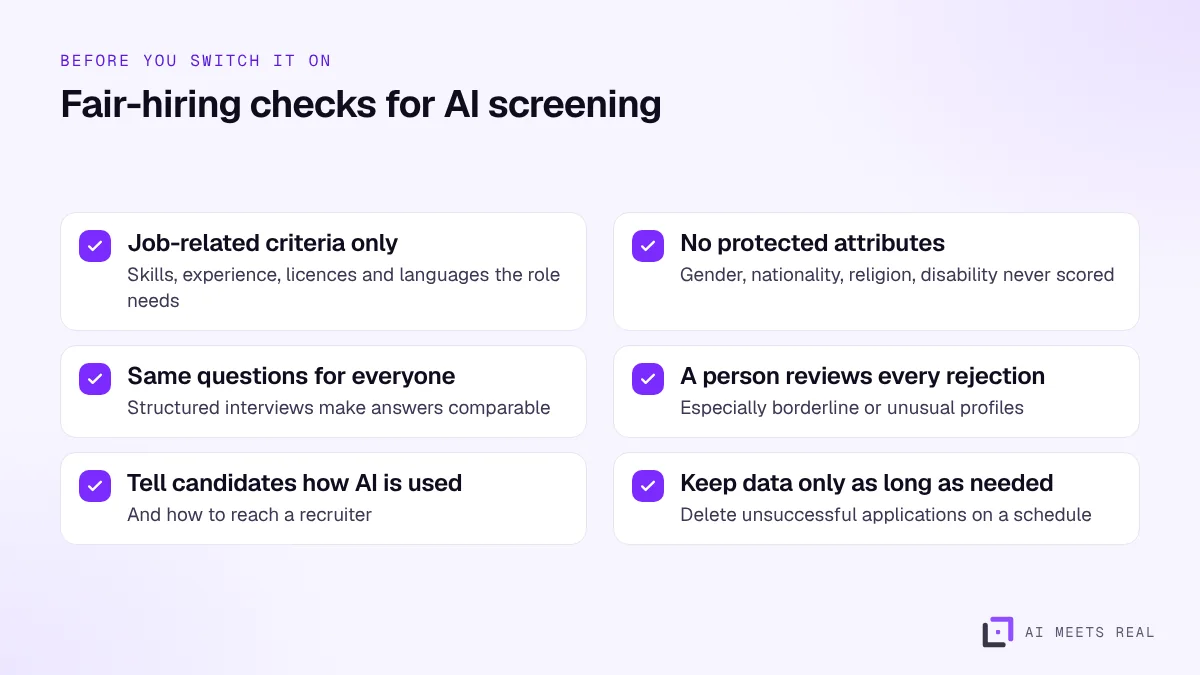
Bias usually enters through vague criteria or historic data. Keep the screening simple and explainable:
Write the criteria down for each role: must-have skills, years of experience, licences, languages and location.
Score only those criteria, and show the reason for every score.
Use structured interviews, so every candidate answers the same questions.
Review a sample of rejected candidates every week for the first month.
Compare outcomes by stage, and investigate any group that drops out much faster than others.
A short checklist to review with HR and legal before the first candidate meets the system.
What does a first month look like?
Week 1: pick one high-volume role, write the criteria and interview questions with the hiring manager, and connect the careers page and WhatsApp number.
Week 2: the agent screens and summarises in shadow mode while recruiters make the real decisions and compare.
Week 3: the agent runs first-round interviews and scheduling, and recruiters approve each shortlist.
Week 4: measure time to shortlist, candidate response time and recruiter hours saved, then decide on the next role.
Measure before you start. Without a baseline of hours per hire and days to shortlist, you will not know whether the system helped.
What does it cost?
Costs depend on volume and channels. Recruiting automation is built on our standard agents and workflows: a one-time setup, then a monthly agent subscription with a fair-use allowance of conversations. See pricing for current figures, or use our ROI model to work out the return from recruiter hours saved.
What mistakes do companies make with AI hiring?
Most problems come from rushing the setup, not from the technology:
Vague criteria. "Good communication skills" cannot be scored fairly. "Has handled customer calls in Arabic and English" can.
Copying old decisions. Training a system on who you hired in the past can repeat the same blind spots. Write the criteria fresh for each role.
No human review of rejections. Strong candidates with unusual careers are the ones a rigid filter drops. Review a sample every week.
Silence. Candidates who never hear back talk about it. Make sure the agent sends a polite update at every stage, including the last one.
Too much data. Asking for photos, dates of birth or family details invites problems and is rarely needed for the decision.
A worked example
Here is how one role might run, with illustrative numbers. A retail group hires 20 sales associates for a new store and receives 600 applications in two weeks. Without AI, two recruiters spend most of those two weeks reading CVs and calling candidates. With an agent:
Every application is read within minutes of arriving and scored against five written criteria, with the reasons shown.
The top 120 are invited to a ten-minute structured chat interview in Arabic or English, at any time that suits them.
Recruiters review the 60 strongest summaries, check a sample of rejections, and invite 40 people to meet the store manager.
The store manager interviews and makes the 20 offers, which HR checks and sends.
The recruiters' time moves from reading and chasing to the conversations that matter. Your own numbers will differ, which is why we measure them in a pilot first.
What is the next step?
Choose one role you hire for often, and book a 30-minute demo. We will run the screening and first-interview flow on a sample of real, anonymised CVs, in English or Arabic, and show where your team stays in control.
Frequently asked questions
Is it legal to use AI to screen job candidates in the UAE?
Yes, as long as the screening is fair and job-related. UAE labour law prohibits discrimination at every stage of recruitment, including shortlisting and assessments, and candidate data must be handled under the UAE's data protection rules. Keep a person responsible for decisions.
Can an AI run job interviews?
An AI can run a structured first-round interview by voice, video or chat, ask the same questions to every candidate and summarise the answers. A recruiter should review the summary and make the decision.
Does AI help with Emiratisation targets?
It helps you reach and process Emirati candidates faster, for example by screening applications quickly and keeping candidates informed. It does not change the targets themselves: companies with 50 or more workers must raise Emirati representation in skilled roles by 2% a year.
What should never be automated in hiring?
Final hiring decisions, offers, salary negotiations and rejections based on judgment. Let the AI prepare and recommend; let a person decide and sign.