
Skip to content

Framework 04 · Any model

Model routing: the right model for each task

Quick tasks go to fast, low-cost models; hard ones go to the strongest. Choose Claude, ChatGPT, Gemini, Kimi or your own model per company, per department or per agent, or let the router decide.

Book a demo
Models
Claude, ChatGPT, Gemini, Kimi, your own
Tiers
Fast, Standard, Deep, Max
Set per
Company, department or agent
Price
Included

In short

Model Routing

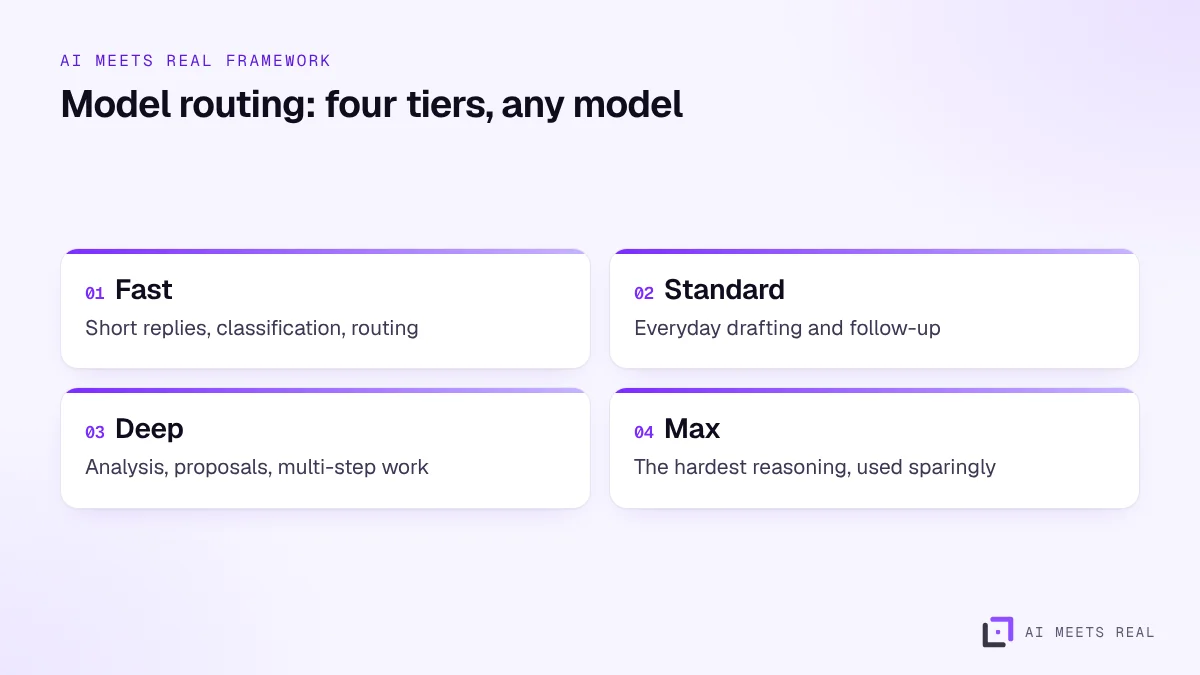
Model routing sends each task to the AI model that does it well at the lowest cost. Tasks are sorted into four tiers: Fast for short replies and classification, Standard for everyday drafting, Deep for analysis and multi-step work, and Max for the hardest reasoning, used sparingly. You can fix one model for the whole company, set one per department or agent, or let the router choose. Switching models never means rebuilding the agents.

Diagram of the four model tiers, Fast, Standard, Deep and Max, with example tasks for each
Four tiers that stay stable while the models behind them change.

How a task is routed

  1. 01

    Classify the task

    Each step of a workflow is tagged by what it needs: speed, writing, analysis or deep reasoning.

  2. 02

    Check the rules

    Your choices apply first: a fixed model, a department setting, or data that must stay on your own model.

  3. 03

    Pick the tier

    Fast, Standard, Deep or Max, based on the task and the rules.

  4. 04

    Run and record

    The task runs on the chosen model; time, tokens and cost are logged against the agent.

  5. 05

    Review monthly

    Quality and cost are reviewed with the owner, and tasks move tier when it pays.

Deliverables

What you get

  • A routing table per agent, written in plain language
  • Spend per model, per agent and per task
  • Your own model supported through an OpenAI-compatible endpoint
  • Model changes without rebuilding the agents

Who does what

AI Meets Real

  • Set up and tune the routing
  • Test quality on your own tasks
  • Report cost and quality every month

Your team

  • Set any rules on models and data
  • Name tasks where quality matters most
  • Approve tier changes for sensitive work

The four tiers

Fast, Standard, Deep and Max

Fast

Short replies, classification, routing.

Standard

Everyday drafting and follow-up.

Deep

Analysis, proposals, multi-step work.

Max

The hardest reasoning, used sparingly.

Models change every few months. The tiers stay the same, so a new model can be tested and swapped in without changing your agents.

Questions about this framework

Which AI models do you work with?

Claude, ChatGPT, Gemini and Kimi, and any model you host behind an OpenAI-compatible endpoint, in your private cloud or on your own servers.

Can we use only one model?

Yes. You can fix one model for the whole company, or set one per department or per agent. The router is optional.

Does routing reduce quality?

It should not. We test each task on your own examples before moving it to a cheaper tier, and keep hard or sensitive tasks on the strongest model.

How do we see what each model costs?

Spend is tracked per model, per agent and per task, and shown in the monthly report.

Find the right model for your tasks

We test your own tasks across models and show quality and cost side by side.