Private AI Models in the UAE: When to Run Your Own Model and Where to Host It
By AI Meets Real teamPublished 5 min read
Key takeaways
A private AI model runs in an environment you control, so prompts and documents do not leave it.
It makes sense for highly sensitive data, strict contract or regulatory requirements, very high volumes, or a need to customise the model.
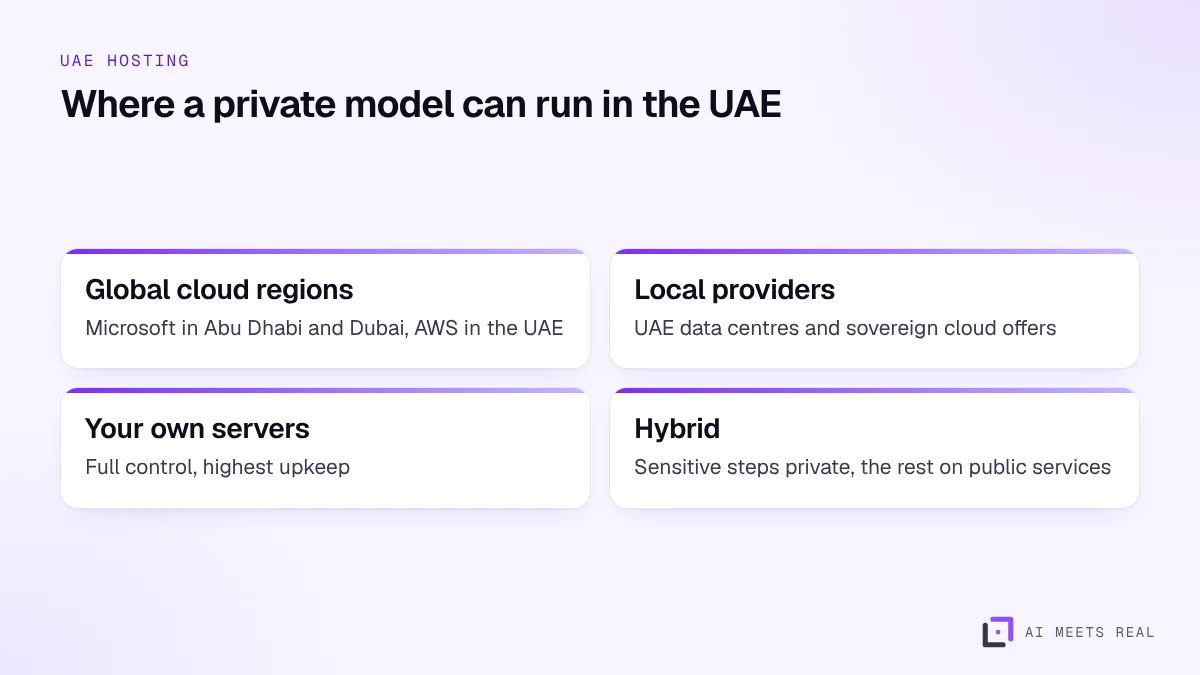
UAE options include major cloud regions in Abu Dhabi and Dubai, local providers, and your own servers.
Private models trade some capability and convenience for control; many companies use a private model for sensitive work and public services for the rest.
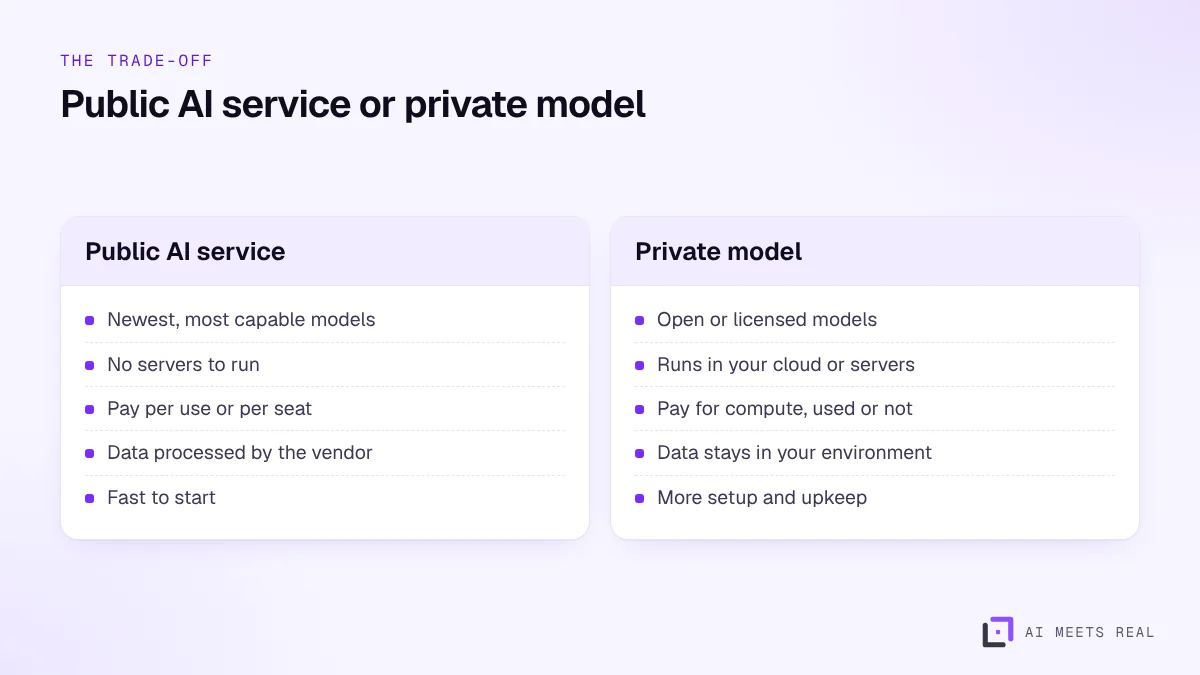
A private AI model is a model that runs in an environment you control, such as your own cloud account in a UAE region or your own servers, so prompts, documents and outputs never leave it. It makes sense when data is highly sensitive, when contracts or regulators require it, when volumes are very high, or when you need to customise the model. For everything else, public AI services on business plans are usually faster, cheaper to start and more capable.
When does a private model make sense?
Consider a private model when at least one of these is true:
The data is highly sensitive. Patient records, legal case files, government documents, salary data or unreleased financial results.
A contract or regulator requires it. Some government, banking and healthcare work requires data to stay in the country or in a specific environment.
Volumes are very high. Millions of documents or messages a month can cost less on your own compute than on per-use pricing.
You need to customise the model. Training on your own terminology or documents, or running it fully offline.
If none of these apply, a business plan from a major provider is usually the better start. OpenAI, for example, says it does not train on business data by default and lists the UAE among its data residency regions for eligible customers (OpenAI). Our comparison of ChatGPT, Claude and Gemini for business covers those options.
Most companies use both: a private model for the most sensitive work and public services for the rest.
What are the UAE hosting options?
The UAE has had major cloud regions for several years. Microsoft opened its first Middle East regions, in Abu Dhabi and Dubai, in June 2019 (TechCrunch), and AWS opened its Middle East (UAE) region, with three availability zones, in August 2022 (AWS).
Large-scale AI infrastructure is also being built. Stargate UAE, a 1-gigawatt AI cluster within a planned 5-gigawatt UAE–US AI campus in Abu Dhabi, involves G42, OpenAI, Oracle, Nvidia, SoftBank and Cisco, with 200MW scheduled for 2026 (Khaleej Times).
The right option depends on your data rules, your volumes and who will run it.
For most companies the choice is between a cloud region in the UAE, a local provider, or a hybrid setup where only the sensitive steps run privately.
Which models can you run privately?
Open models, whose weights you can download and run yourself, have improved quickly. They now handle many business tasks well: classifying messages, extracting fields from documents, summarising, drafting and answering questions from your own knowledge base.
For Arabic, the UAE has produced its own open models. Jais, released in August 2023 by Inception (a G42 company) with MBZUAI and Cerebras, was launched as an open Arabic and English model (Cerebras). Newer open models from several labs also handle Arabic.
Be realistic about the hardest tasks. Complex reasoning, long multi-step planning and difficult legal or technical analysis are still usually done best by the largest commercial models. A common answer is to route: private model for sensitive steps, commercial model for hard steps with personal data masked. Our model routing framework explains how.
What does a private model cost?
The cost model is different from public services:
Compute. GPU servers cost money whether you use them or not, unless you scale them down outside working hours.
Setup. Choosing the model, deploying it, connecting it to your systems and testing it.
Upkeep. Updates, monitoring, security patches and someone responsible for it.
Private models become cheaper than per-use services mainly at high, steady volumes. At low volumes they usually cost more. Our ROI model helps compare the two on your expected usage.
How do you keep a private model secure?
Running it yourself means the security is yours too:
Put it in a private network with no public access.
Control who and which systems can call it, and log every request.
Keep personal data out of logs, or mask it.
Test it for wrong or harmful answers before staff rely on it.
Government entities, banks and healthcare providers in the UAE often have stricter hosting rules than the federal data protection law alone. If you work in these sectors, start with your regulator's requirements. Our government page and enterprise page explain how we work under those rules, and our article on AI in UAE government covers the public sector context.
How do you decide?
List your use cases and the data each one touches.
Mark the ones where data must stay in your environment.
Test an open model on those tasks against a commercial model.
Estimate the volume and compare the monthly cost of both options.
Start hybrid if only some tasks need privacy.
A five-day AI audit covers exactly this assessment.
What mistakes do companies make with private models?
Going private by default. Running your own model for tasks that do not need it adds cost and upkeep with no benefit.
Underestimating upkeep. Models, libraries and drivers need updates. Someone has to own them.
Skipping the comparison. Test the private model against a commercial one on the same tasks, so you know the quality you are trading.
Leaving it open. A private model on a public endpoint is not private. Keep it inside your network.
Logging everything. Prompt logs can contain the very data you wanted to protect. Mask or limit them.
A worked example
With illustrative choices: a healthcare group wants AI to summarise patient referral letters and draft replies to patients. The referral letters contain medical details, so summarising runs on an open model hosted in the group's own cloud account in a UAE region. Patient replies use only appointment details, so names and identifiers are masked and the drafting step uses a commercial model under a business agreement. A person approves every reply. The sensitive data never leaves the group's environment, and the team still gets the quality of a large model where it matters.
What is the next step?
Book a 30-minute demo. We will look at your use cases and data rules, and tell you whether a private model, a public service or a hybrid fits, with a hosting option and a cost estimate.
Frequently asked questions
What is a private AI model?
An AI model that runs in an environment you control, such as your own cloud account or servers, rather than on a shared public service. Your prompts, documents and outputs stay inside that environment.
Is a private model as good as ChatGPT or Claude?
Usually not for the hardest tasks, but open models are now good enough for many business jobs such as classification, extraction, summarising and drafting. Test on your own tasks before deciding.
Where can I host an AI model in the UAE?
Options include Microsoft Azure regions in Abu Dhabi and Dubai, the AWS region in the UAE, local providers, and your own data centre. Large new AI infrastructure is also being built in Abu Dhabi.
Does the UAE require data to stay in the country?
It depends on your sector and contracts. Government entities, regulated financial services and healthcare often have stricter rules. The federal data protection law also sets conditions for transferring personal data abroad. Check your sector's rules with your legal adviser.