Arabic AI Chatbots in the UAE: What Works for Gulf Customers in 2026
Most UAE customers switch between Arabic, English and Arabizi in one chat. Here is how to build an Arabic AI chatbot that copes, from dialect to voice to hand-over.
Read reportBy AI Meets Real teamPublished 6 min read
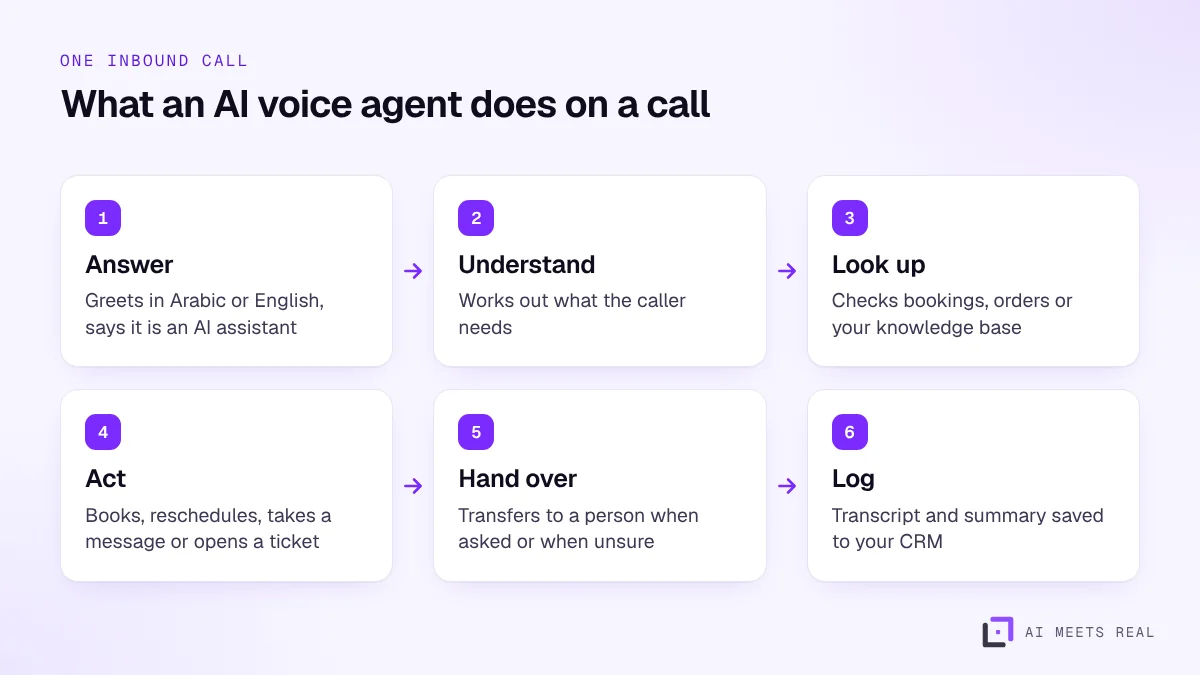
An AI voice agent answers and makes phone calls in natural speech, in Arabic or English. For UAE businesses it is most useful on inbound calls: answering common questions, booking and rescheduling appointments, taking messages after hours and routing callers to the right person. Outbound calling is possible too, but marketing calls must follow the UAE telemarketing rules, and every call should offer a quick way to reach a person.
Phone calls are still the main channel for many UAE customers, especially in healthcare, real estate, automotive and home services. The problem is coverage: calls arrive during busy hours, after hours and on weekends, and every missed call is a customer who may try a competitor next.
Typical jobs for a voice agent:
Our AI agents page lists the voice and chat agents we deploy, and the AI customer support page shows how voice fits next to WhatsApp and email.
Current voice agents understand and speak Gulf Arabic and English, and can switch mid-call when the caller does. They are good with common requests and clear speech. They are weaker with heavy background noise, unusual names and very long, mixed-language sentences.
Three things make Arabic calls work well:
Our article on Arabic AI chatbots covers the same questions for text channels.
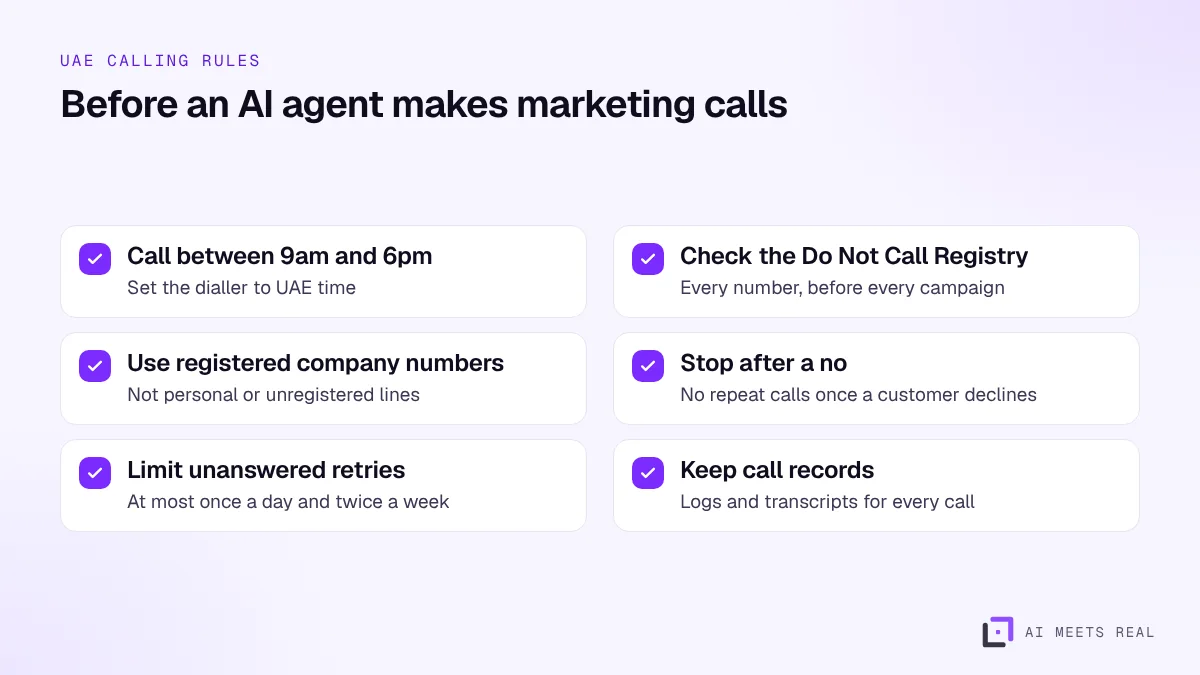
Marketing calls in the UAE are covered by Cabinet Resolution No. 56 of 2024, with penalties set out in Resolution No. 57, in force since 27 August 2024 (Clyde & Co). The main rules:
Fines for calling people on the registry start at AED 50,000 for a first violation and rise to AED 150,000 for repeat violations. The rules do not mention AI specifically, so treat an AI agent exactly like a human caller: the same hours, the same lists and the same records.
Calls to existing customers about their own booking or order are service calls rather than marketing, but keep them relevant and polite, and stop when asked.
A voice agent should never trap a caller. The basic controls we set up on every deployment:
These controls come from our agent governance framework. Call recordings and transcripts are personal data under the UAE data protection law (UAE Government portal), so set a retention period and limit who can listen to them.
Speed is the main reason businesses add a voice agent. Research published in Harvard Business Review found that companies that contacted a lead within an hour were nearly seven times as likely to qualify it as those that waited longer, and more than 60 times as likely as those that waited 24 hours or more (SmartCompany summary of the HBR study). A voice agent answers in seconds, at any hour. Our guide to lead response time covers the full picture.
A voice agent is scoped and quoted after a short call, because call volumes and telephony costs vary from business to business. See pricing for our setup packages and agent subscriptions.
With illustrative numbers: a clinic group receives around 1,500 calls a month, and about a fifth arrive when reception is busy or closed. Many of those callers want to book, move or cancel an appointment.
An AI voice agent answers every call. It books, moves and cancels appointments directly in the clinic system, answers questions about locations, hours and accepted insurance, and transfers anything clinical or urgent to staff straight away. Reception staff start each morning with a short list of messages and call-backs instead of a voicemail box. The pilot measures how many of those previously missed calls become booked appointments.
Book a 30-minute demo and hear an AI voice agent handle your most common call, in Arabic and English, connected to a test calendar. We will also show the transcript and the hand-over to a person.
Software that answers and makes phone calls in natural speech. It understands what the caller says, looks up information in your systems, takes actions such as booking an appointment, and hands the call to a person when needed.
Yes. Current voice agents handle Gulf Arabic and English, and can switch when the caller switches. Test with your own customers' accents and vocabulary before going live, and keep a fallback to a person.
Marketing calls must follow Cabinet Resolution No. 56 of 2024: calls only between 9am and 6pm, from numbers registered to the company, no calls to people on the Do Not Call Registry, and no repeat calls after a customer declines. Service calls to existing customers, such as appointment reminders, are lower risk but still need care.
We recommend it. A short line at the start of the call builds trust, and callers who prefer a person can ask for one straight away.
VoiceAI AgentsCustomer ServiceTelemarketing
Most UAE customers switch between Arabic, English and Arabizi in one chat. Here is how to build an Arabic AI chatbot that copes, from dialect to voice to hand-over.
Read report
AI agents answer, qualify, chase and report around the clock. Here is what they do well in UAE companies, where they need a human, and how to deploy one safely.
Read report
WhatsApp is where UAE customers reply. Here is how the WhatsApp Business API works in 2026: per-message pricing, Meta's AI chatbot policy, templates, opt-in and putting an AI agent on it.
Read report