Lead Response Time: Why the First Hour Decides Most UAE Sales
By AI Meets Real teamPublished 5 min read
Key takeaways
Companies that contact a lead within an hour are far more likely to qualify it than those that wait, according to research published in Harvard Business Review.
Measure response time from the moment the lead arrives to the first useful reply, including nights and weekends.
AI can reply in seconds on WhatsApp, web chat and phone, ask the qualifying questions and book a meeting with a salesperson.
Phone follow-up must respect the UAE telemarketing rules: calls between 9am and 6pm and no repeat calls after a no.
Lead response time is the time between a lead arriving and your first useful reply. It matters because interest fades fast: research published in Harvard Business Review found that companies contacting a lead within an hour were nearly seven times as likely to qualify it as those that waited longer. For UAE businesses, where many leads arrive on WhatsApp and after office hours, the quickest way to close the gap is an AI agent that replies in seconds and books a salesperson.
What does the research say?
The most cited study is an audit of 2,241 US companies, published in Harvard Business Review in 2011 (HBR). It found (SmartCompany summary):
Only 37% of companies responded to an online lead within an hour.
23% never responded at all.
The average response time, among those that replied within 30 days, was 42 hours.
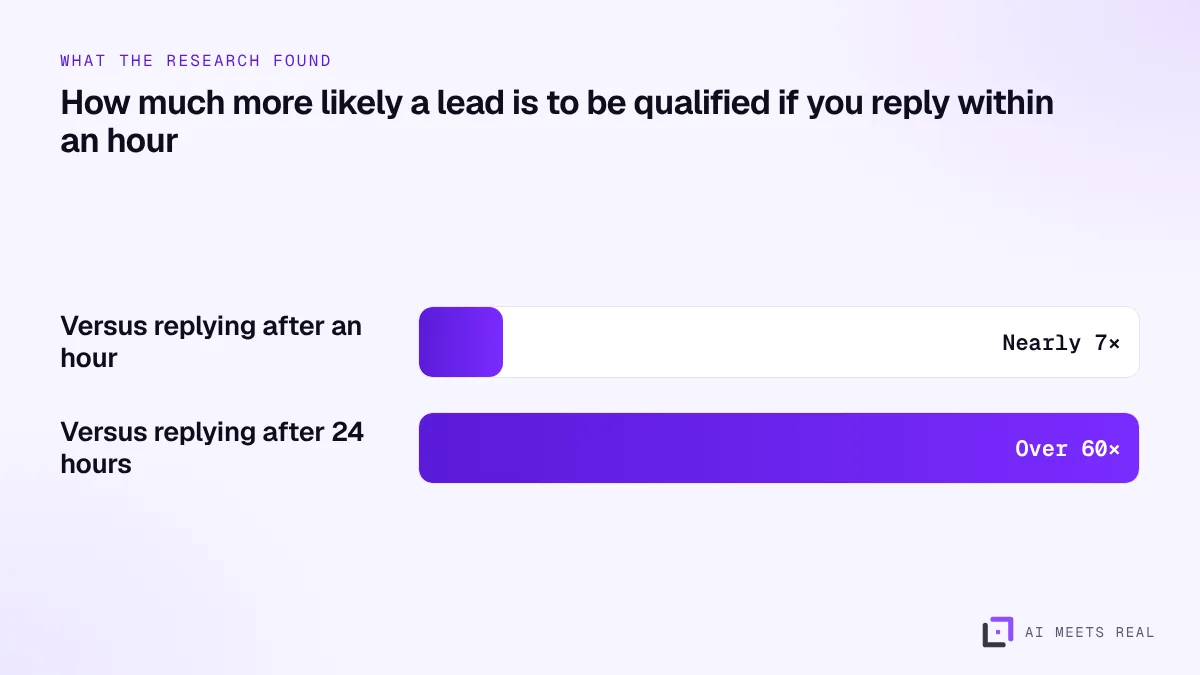
Firms that contacted the lead within an hour were nearly seven times as likely to qualify it as those that waited even an hour longer, and more than 60 times as likely as those that waited 24 hours or more.
From an audit of 2,241 US companies published in Harvard Business Review (2011). Your own rates will differ; the pattern is what matters.
The study is old and was done in the US, but the pattern matches what UAE sales teams tell us: the first business to reply properly usually gets the meeting.
How do you measure your real response time?
Most companies think they are faster than they are. Measure it honestly for two weeks:
Start the clock when the lead arrives: the form submission, the first WhatsApp message, the portal enquiry or the missed call.
Stop the clock at the first useful reply from a person or an agent. An automatic "thanks, we will be in touch" does not count.
Include nights, weekends and public holidays. That is where most of the delay hides.
Report the median and the slowest 10%, not just the average.
Split by channel and source, because WhatsApp, portals and web forms often behave very differently.
Most CRMs can report this if the lead source and first reply are logged. Our AI for sales and CRM page shows how we set up the tracking.
Why are UAE leads harder to answer fast?
WhatsApp first. Many customers prefer to message, and expect a reply within minutes, at any hour.
Two languages. A lead may write in Arabic, English or both, and needs a reply in the same language.
Portals and many sources. Property portals, car marketplaces, social ads, Google and walk-ins all feed different inboxes.
Different working weeks. Enquiries arrive on Friday afternoons, Saturdays and late evenings, when teams are off.
How does AI close the gap?
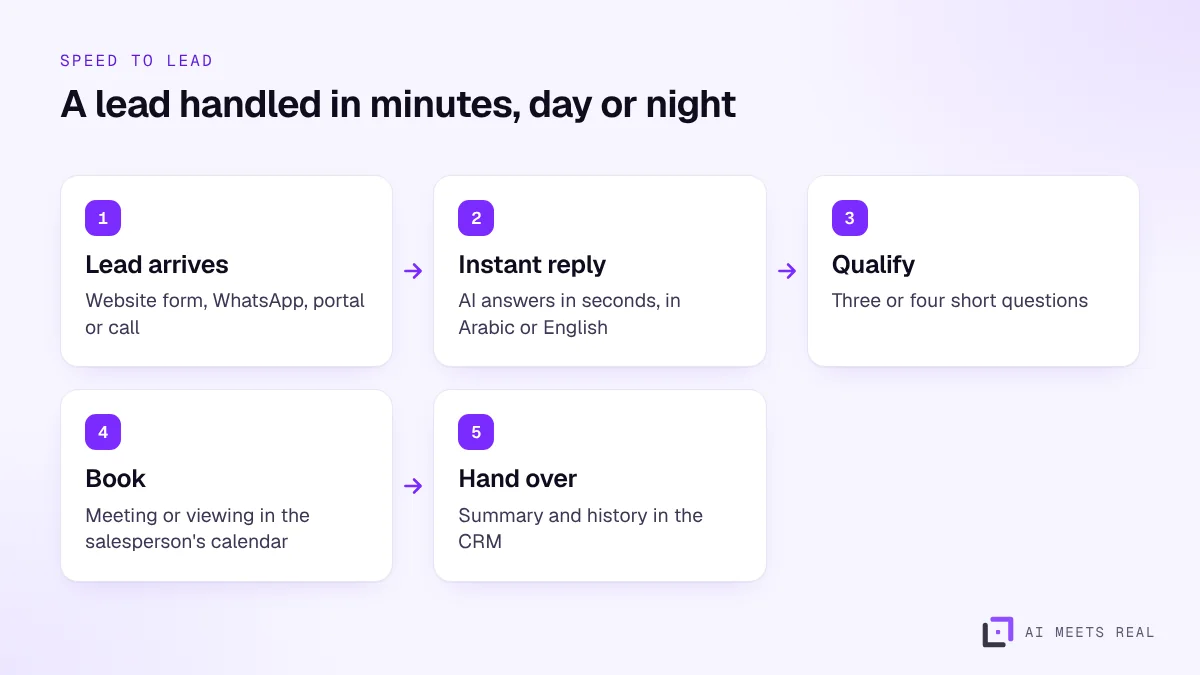
An AI sales agent covers the first minutes of every lead, on every channel:
Replies in seconds on WhatsApp, web chat, email or phone, in the customer's language.
Answers the common questions from your approved information: prices, availability, locations, next steps.
Asks three or four qualifying questions, such as budget, timing and what the customer needs.
Books a meeting directly in the salesperson's calendar, or a viewing or test drive.
Hands over with a short summary in the CRM, so the salesperson does not ask the same questions again.
The salesperson starts the first call already knowing what the customer wants.
Calling is still effective, but outbound marketing calls in the UAE must follow Cabinet Resolution No. 56 of 2024: calls only between 9am and 6pm, from numbers registered to the company, no calls to numbers on the Do Not Call Registry and no repeat calls after the customer declines (Clyde & Co). A lead who asked to be contacted is a different situation from a cold call, but keep the same hours and stop when asked.
A good pattern: the AI agent replies on the channel the lead used, books a call at a time the customer chooses, and the salesperson calls at that time.
Which industries gain the most?
Real estate, where portal leads go to several agencies at once. See our real estate solutions.
Automotive, where test-drive requests cool quickly. See our automotive solutions.
Healthcare and clinics, where patients book with whoever answers first. See our healthcare solutions.
Education and training, where enquiries peak in the evening.
How do you start?
Measure your current response time for two weeks.
Connect one channel, usually WhatsApp or the website form, to an AI agent.
Write the qualifying questions and the hand-over rules with your sales lead.
Run a 14-day pilot and compare response time, meetings booked and show-up rate.
Use our ROI model to put a value on the extra meetings, and see pricing for agent costs.
What mistakes keep response times slow?
Counting the auto-reply. "Thanks for your message" is not a response. Measure the first useful answer.
Leads in too many inboxes. Portal emails, WhatsApp on personal phones and website forms in a shared mailbox are impossible to track. Bring them into one place first.
Asking too many questions. A lead asked ten questions before getting an answer often leaves. Ask three or four, and answer theirs first.
No hand-over rule. Decide when the agent books a meeting, when it passes the lead to a person straight away, and who gets which leads.
Forgetting old leads. Leads that went quiet months ago can be re-engaged politely, within the messaging and calling rules.
A worked example
With illustrative numbers: a real estate brokerage receives about 400 portal and website leads a month. Its median first reply is three hours during the week and much longer at weekends, and agents call leads back when they can.
With an AI agent on WhatsApp and the website, every lead gets a reply within a minute in Arabic or English, with the property details and three questions about budget, timing and area. Qualified leads are offered viewing slots from the agent's calendar. The broker starts each viewing knowing what the client wants. The pilot compares viewings booked and deals closed per hundred leads against the previous month.
What is the next step?
Book a 30-minute demo. We will send a test lead through your website or WhatsApp number and show the reply, the qualifying questions and the booked meeting, in Arabic and English.
Frequently asked questions
What is a good lead response time?
Within five minutes during working hours is a strong target, and within an hour is the minimum. The research most often cited found leads contacted within an hour were nearly seven times as likely to be qualified as those contacted later.
How do I measure lead response time?
Record the time each lead arrives and the time of the first useful reply, not an automatic acknowledgement. Include leads that arrive at night and at weekends, and report the median and the slowest 10%.
Can AI reply to leads on WhatsApp?
Yes. An AI agent connected to the WhatsApp Business Platform can reply in seconds, answer common questions, ask qualifying questions and book a meeting, then hand the conversation to a salesperson.
Will customers mind talking to an AI first?
Most customers care more about a fast, useful answer than about who gives it. Say clearly that it is an AI assistant, keep the questions short and make it easy to reach a person.