Zapier vs Make vs n8n: Which Automation Platform Fits a UAE Business?
By AI Meets Real teamPublished 5 min read
Key takeaways
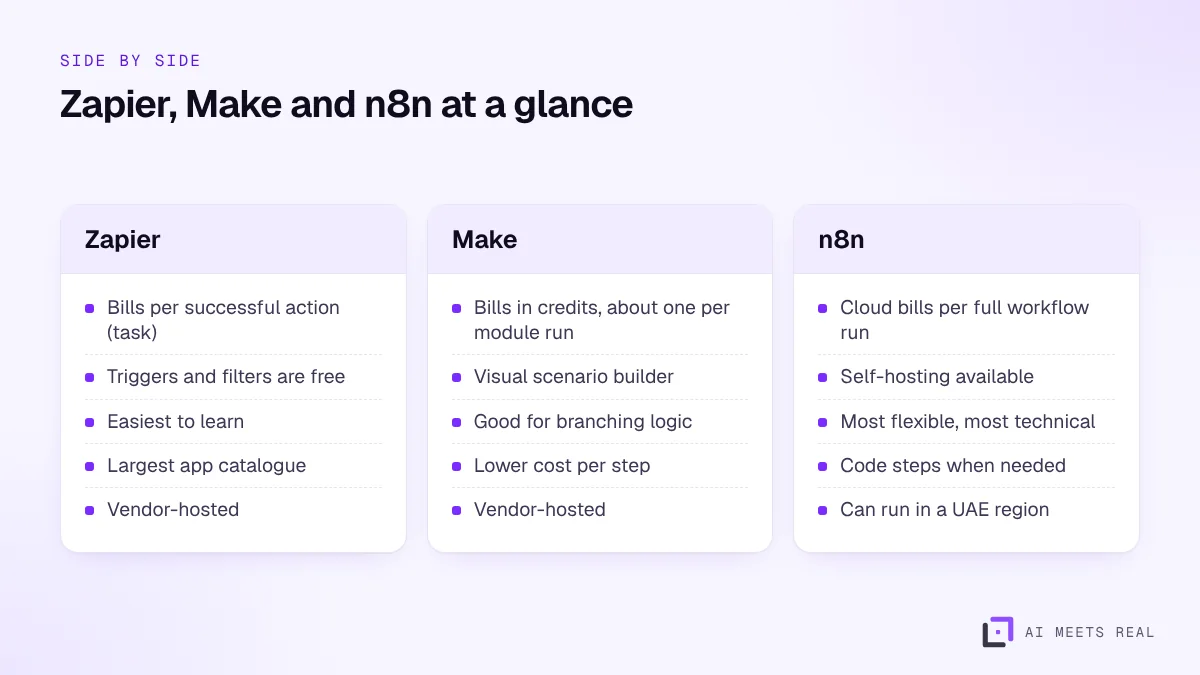
Zapier is the easiest to start with and has the most app connections; it bills per successful action (task).
Make suits more complex, visual workflows at a lower cost per step; it bills in credits, roughly one per module run.
n8n bills per full workflow run on its cloud plans and can be self-hosted, which keeps data in a UAE region you control.
Choose by who will build and maintain the workflows, how many steps each run has, and where your data must stay.
Zapier, Make and n8n all connect your apps and automate repetitive work, but they suit different teams. Zapier is the easiest to start with and bills per successful action. Make suits more complex, visual workflows and bills in credits per module run. n8n bills per full workflow run on its cloud plans and can be self-hosted, which keeps data in an environment you control. For most UAE businesses the right choice depends on who will build and maintain the workflows, how long each workflow is, and where the data must stay.
How does each platform bill?
The billing unit matters more than the plan price, because it decides how cost grows as you automate more.
Zapier counts tasks. A task is any successful action step. Triggers never use tasks, and filter or paths steps do not count either (Zapier Help Center). A five-step Zap that runs 1,000 times can use up to 5,000 tasks.
Make counts credits. Make switched from operations to credits on 5 August 2025; for non-AI modules, one operation uses one credit, and Make's own AI features can use more (Make Help Center).
n8n cloud plans count executions, where one execution is a complete run of a workflow regardless of how many steps it has. The self-hosted community edition has no execution limit; you pay for the server and the upkeep instead (Nordflux).
How each platform bills and who it suits. Check current plan limits on each vendor's site.
So for short workflows with few steps, the three are close. For long workflows with ten or twenty steps, per-run billing on n8n is usually much cheaper.
Who is each platform best for?
Zapier suits small teams and non-technical staff who want to connect common apps quickly: a form to a CRM, a new deal to a Slack message, an invoice to a spreadsheet. It has the largest catalogue of ready-made app connections. Read our Zapier guide for UAE businesses.
Make suits operations teams who need branching logic, loops and data transformation in a visual builder, and want a lower cost per step. Read our Make guide.
n8n suits companies with a technical owner, long or complex workflows, or strict rules about where data lives. It allows code steps when the visual nodes are not enough. Read our n8n self-hosting guide.
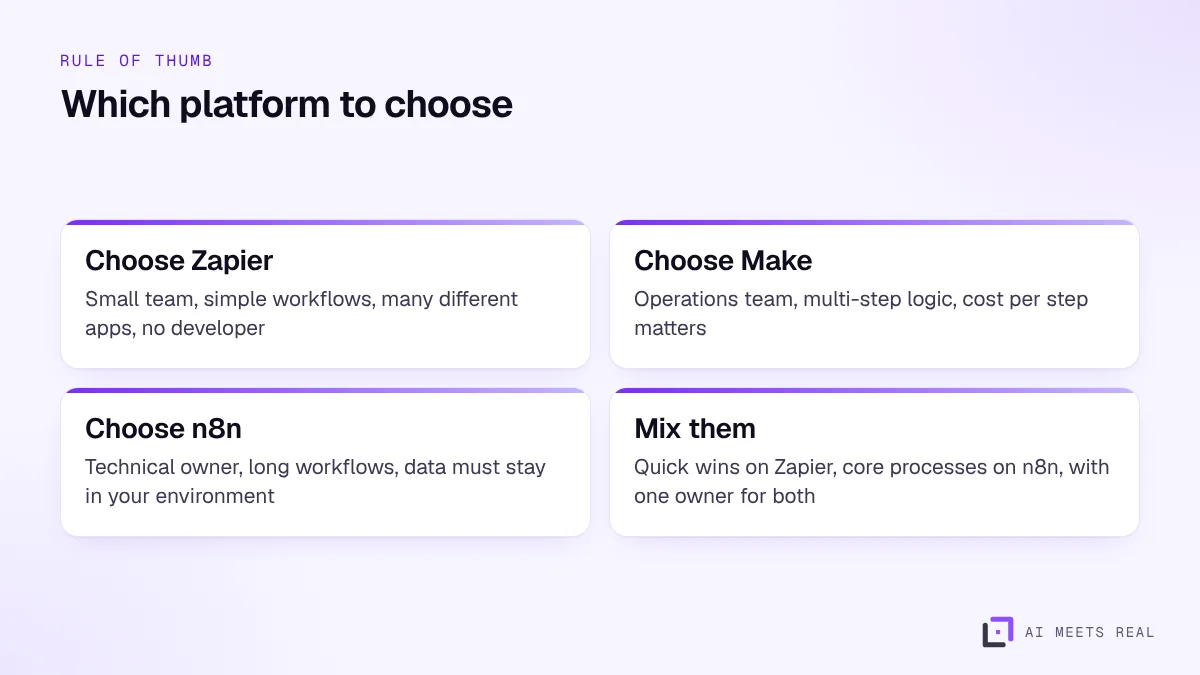
Most companies pick on who will build and maintain the workflows, not on features.
Where does your data live?
This is often the deciding question in the UAE.
Hosted platforms process your workflow data on the vendor's servers. Check the hosting regions and the data processing terms, especially for customer, patient or employee data.
Self-hosted n8n runs on a server you choose, such as a cloud region in the UAE or your own data centre, so workflow data stays in your environment.
One licensing point: n8n's Sustainable Use License allows free self-hosting for your own internal business processes, but reselling or offering n8n as a hosted service to others needs a commercial licence.
What about AI agents?
All three platforms can now call AI models such as ChatGPT, Claude and Gemini as a step, and all three have added agent features that let a model decide which step to run next. That is useful, but agents need more than a workflow:
Approvals before anything is sent to a customer or moves money.
Logs of what the agent did and why.
Access limits, so the agent can only touch the systems it needs.
Yes, and many companies do. A common pattern is to let teams build quick, simple automations in Zapier, and run the core business processes, the ones that must not fail, on n8n or Make with one clear owner. The risk is sprawl: dozens of workflows nobody owns. Keep a simple register of every workflow, its owner and what it touches.
How do you decide?
Answer four questions:
Who will build and fix the workflows? Non-technical staff point to Zapier; an operations analyst to Make; a developer or technical owner to n8n.
How many steps does a typical run have? More steps favour per-run billing.
How many runs a month? Estimate it, then price it on each platform's current plans.
Where must the data stay? If the answer is "in the UAE" or "in our own environment", self-hosted n8n is the simplest route.
What mistakes do companies make with automation platforms?
Choosing on the free plan. Free plans hide how cost grows. Price your expected volume on each platform before you build.
No owner. Workflows built by one enthusiastic employee break when they leave. Every workflow needs a named owner and a short description.
No error alerts. A workflow that fails silently for a week does more damage than no workflow. Turn on failure notifications from day one.
Personal accounts. Workflows connected to someone's personal login stop when their password changes. Use shared service accounts with proper access.
Automating a broken process. If the manual process is unclear, automating it only makes the confusion faster. Fix the steps first.
A worked example
With illustrative numbers: a distributor wants to automate order handling. Each order runs through about 12 steps: read the order email, check stock, create the sales order, update the CRM, notify the warehouse, send a confirmation and so on. It processes about 3,000 orders a month.
On a per-action platform, that is up to 36,000 billable actions a month. On a per-step credit model, about the same number of credits. On per-execution billing, it is 3,000 executions, and on self-hosted n8n there is no execution charge, only the server and upkeep. For this shape of workflow, per-run billing is usually far cheaper. For a team that runs 200 two-step automations a month, the difference is small and ease of use matters more.
What is the next step?
Book a 30-minute demo and bring a list of the workflows you want to automate. We will recommend a platform, estimate the monthly cost on each, and show one workflow running. See pricing for our setup packages.
Frequently asked questions
Which is cheapest: Zapier, Make or n8n?
It depends on the shape of your workflows. Zapier charges per successful action, Make per module run (credit), and n8n cloud per full workflow run. For long workflows with many steps, n8n is usually cheapest, and self-hosted n8n has no execution charge at all, though you pay for the server and maintenance.
Which is easiest for non-technical staff?
Zapier is generally the easiest to learn. Make is visual but takes a little longer. n8n is the most flexible and the most technical.
Can I keep automation data in the UAE?
With n8n you can self-host on a UAE cloud region or your own servers, so workflow data stays where you choose. With hosted platforms, check the vendor's hosting regions and data processing terms.
Can these platforms run AI agents?
All three can call AI models such as ChatGPT or Claude as steps in a workflow, and all three have added AI agent features. For agents that need approvals, logging and access controls, plan the governance as well as the workflow.